
Academic Workflow - Any Suggestion for an Application/s?
Started by Darren McDonald
on 10/22/2019
Darren McDonald
10/22/2019 11:45 am
I am trying completely go digital with my workflow as a researcher in management studies in Japan. The main reason for doing so is that a stroke has left me with awful handwriting and a terrible short-term memory. (Up until the stroke, I made notes in a research journal and typed up my findings in Word). I tried unsuccessfully to find all I need in one application. But now I am starting to understand that a workflow involves drawing on the best of several different applications.
At the moment, I am trying to decide on an application to use when reading PDFs, making annotations and taking notes. The closest application that works for me is Highlights https://highlightsapp.net . I like it for two reasons. The first reason, you can see all your notes and annotations at once in the application, rather than just having lots of "memo icons" on the PDF that you have to click open to read the comment you made. Secondly, the ability to export your annotations and notes for use in another application. What holds me back is that there is no iPad app. Do you have any suggestions?
Another thing I am trying to do is find an application that helps me bring together the annotations and notes to find themes and decide where I use them in a journal article. Any suggestions on what application to use to do this?
Looking forward to your suggestions as I am in the middle of working on a chapter for a book. :)
Cheers! :)
Darren
At the moment, I am trying to decide on an application to use when reading PDFs, making annotations and taking notes. The closest application that works for me is Highlights https://highlightsapp.net . I like it for two reasons. The first reason, you can see all your notes and annotations at once in the application, rather than just having lots of "memo icons" on the PDF that you have to click open to read the comment you made. Secondly, the ability to export your annotations and notes for use in another application. What holds me back is that there is no iPad app. Do you have any suggestions?
Another thing I am trying to do is find an application that helps me bring together the annotations and notes to find themes and decide where I use them in a journal article. Any suggestions on what application to use to do this?
Looking forward to your suggestions as I am in the middle of working on a chapter for a book. :)
Cheers! :)
Darren
MadaboutDana
10/22/2019 1:41 pm
Hi Darren,
Sounds like an interesting query! But it would be useful to know more about your working environment. It sounds as if you prefer to work on iPad (any particular type? Always interesting to know!). But do you also work on macOS? Or on some other platform (e.g. Windows, Linux etc.)?
Many thanks and best,
Bill
Sounds like an interesting query! But it would be useful to know more about your working environment. It sounds as if you prefer to work on iPad (any particular type? Always interesting to know!). But do you also work on macOS? Or on some other platform (e.g. Windows, Linux etc.)?
Many thanks and best,
Bill
J J Weimer
10/22/2019 1:42 pm
Secondly, the ability to export your annotations and notes for use in another application. What holds me back is that there is no iPad app. Do you have any suggestions?
At one level, you will find apps such as PDFExpert and PDFPen. They expand the tool sets to the iPad with additional markup options. I believe that both have been given high regards on this forum.
PDFPen -> https://smilesoftware.com/pdfpen-family/
PDFExpert -> https://pdfexpert.com/ios
Perhaps GoodNotes and others can be added, although I consider them to be note-taking plus PDF markup rather than dedicated PDF markup.
Going further, you will find apps such as LiquidText and MarginNote. They include their own internal options to extract the annotations to a side sheet and organize them for review. The downside of these two is that the annotations they create are not always compliant with other PDF editors.
LiquidText -> https://www.liquidtext.net
MarginNote -> https://www.marginnote.com
Another thing I am trying to do is find an application that helps me bring together the annotations and notes to find themes and decide where I use them in a journal article. Any suggestions on what application to use to do this?
You may find that MarginNote (or LiquidText), with their additional study sheet approach, will provide a framework that you can use directly without having to export the annotations to other apps. In this regard, I particularly appreciate the approach in MarginNote to be able to put tags on annotations.
Personally, I use PDFExpert to do markup that must be compliant with the rest of the world (e.g. when I have to markup documents that are to be sent to the Windows community). I also appreciate the ability in PDFExpert to be able to access multiple cloud services (Google Personal + Google Work + Dropbox Personal + Dropbox Work + ...). I use MarginNote to make annotations that I want to tag for some reason or another (e.g. when I grade documents, I can mark tags such as "incorrect", "inadequate", or "improper" to denote different levels of mistakes). I do not use the collect or study aspects of MarginNote even though these two additional aspects are touted as the main reason for MarginNote to be used (markup + collect + study). I do not appreciate the limitations and general instabilities that MarginNote has in syncing only with iCloud (and have given it a low review on the App Store for this reason).
Luhmann
10/22/2019 2:44 pm
I use Paperpile to organize PDFs, PDF Expert to highlight and annotate. (Although Paperpile's built in PDF reader - in beta - is getting better.) I then export annotations to Dynalist for organizing and search.
Darren McDonald
10/22/2019 2:44 pm
Hello Bill,
I work mainly on macOS (iMac and MacBookAir) and also use an iPad (iPad Air with Apple Pencil support) for close, active reading. I could use a Windows-only application if the software is only Windows. I have Windows 10 running in Parallels. But I would prefer osMac-friendly applications.
Any suggestions would really help. :)
Cheers! :)
It sounds as if you prefer to work on
iPad (any particular type? Always interesting to know!). But do you also
work on macOS? Or on some other platform (e.g. Windows, Linux etc.)?
I work mainly on macOS (iMac and MacBookAir) and also use an iPad (iPad Air with Apple Pencil support) for close, active reading. I could use a Windows-only application if the software is only Windows. I have Windows 10 running in Parallels. But I would prefer osMac-friendly applications.
Any suggestions would really help. :)
Cheers! :)
Daly de Gagne
10/22/2019 3:14 pm
Although only available in the Windows world, Citavi is probably the best ref manager, pdf reader, and knowledge manager on the market. Its ability to manage knowledge is unique, and could mimic effectively the research journal, while allowing information to be organized usefully. There is also a built-in task manager which allows organization of the many details and tasks implicit in academic work.
Even if someone never ends up using Citavi, its website offers Information which may be useful.
www.citavi.com
Nothing else I have seen comes close to Citavi.
Daly
Even if someone never ends up using Citavi, its website offers Information which may be useful.
www.citavi.com
Nothing else I have seen comes close to Citavi.
Daly
Darren McDonald
10/22/2019 3:30 pm
Hello J J Weimer,
Actually, it was reading the recommendations in this forum that had me trying out PDFExpert on my iMac, MacBookAir and iPad. I now have PDFExpert as my general default PDF reader! :)
In terms of using a PDF editor in my workflow, I am after something similar to Highlights where the highlights and notes appear as text and images in a window to the side of the PDF. These notes are linked to the PDF itself and can be imported into other applications. PDFExpert and PDFPen do not have this extra window with the notes appearing as little icon images on the PDF which you have to click to read what they are.
In this regard, your suggestion of LiquidText and MarginNote seems inline with my needs. You wrote ...
At first, I was excited by the features of these two applications. But their weakness comes from the point you raised about them not being compliant with other PDF editors. They do not to be compliant with other PDF editors as such, but I need the highlights and notes I made in the application export to another application.
In my search for an application for the iPad I came across Flexcil https://www.flexcil.com . Have you tried this application?
I need to investigate this study sheet approach further in the applications MarginNote (both on macOS and iOS) and LiquidText (iOS only, unfortunately). I need to see if they can help bring together a lot of different quotes and notes made on different PDFs into themes and concepts.
I would be sort of following a Grounded Theory approach to the analysis of the literature. Mm ...
Tagging would be one way I could do this. I will try and find out some more.
If I have sparked your mind for other suggestions or ways of doing things, they would be most welcome! :)
At one level, you will find apps such as PDFExpert and PDFPen. They
expand the tool sets to the iPad with additional markup options. I
believe that both have been given high regards on this forum.
PDFPen -> https://smilesoftware.com/pdfpen-family/
PDFExpert -> https://pdfexpert.com/ios
Actually, it was reading the recommendations in this forum that had me trying out PDFExpert on my iMac, MacBookAir and iPad. I now have PDFExpert as my general default PDF reader! :)
In terms of using a PDF editor in my workflow, I am after something similar to Highlights where the highlights and notes appear as text and images in a window to the side of the PDF. These notes are linked to the PDF itself and can be imported into other applications. PDFExpert and PDFPen do not have this extra window with the notes appearing as little icon images on the PDF which you have to click to read what they are.
In this regard, your suggestion of LiquidText and MarginNote seems inline with my needs. You wrote ...
Going further, you will find apps such as LiquidText and MarginNote.
They include their own internal options to extract the annotations to a
side sheet and organize them for review. The downside of these two is
that the annotations they create are not always compliant with other PDF
editors.
LiquidText -> https://www.liquidtext.net
MarginNote -> https://www.marginnote.com
At first, I was excited by the features of these two applications. But their weakness comes from the point you raised about them not being compliant with other PDF editors. They do not to be compliant with other PDF editors as such, but I need the highlights and notes I made in the application export to another application.
In my search for an application for the iPad I came across Flexcil https://www.flexcil.com . Have you tried this application?
You may find that MarginNote (or LiquidText), with their additional
study sheet approach, will provide a framework that you can use directly
without having to export the annotations to other apps. In this regard,
I particularly appreciate the approach in MarginNote to be able to put
tags on annotations.
I need to investigate this study sheet approach further in the applications MarginNote (both on macOS and iOS) and LiquidText (iOS only, unfortunately). I need to see if they can help bring together a lot of different quotes and notes made on different PDFs into themes and concepts.
I would be sort of following a Grounded Theory approach to the analysis of the literature. Mm ...
Personally, I use PDFExpert to do markup that must be compliant with the
rest of the world (e.g. when I have to markup documents that are to be
sent to the Windows community). I also appreciate the ability in
PDFExpert to be able to access multiple cloud services (Google Personal
+ Google Work + Dropbox Personal + Dropbox Work + ...). I use MarginNote
to make annotations that I want to tag for some reason or another (e.g.
when I grade documents, I can mark tags such as "incorrect",
"inadequate", or "improper" to denote different levels of mistakes). I
do not use the collect or study aspects of MarginNote even though these
two additional aspects are touted as the main reason for MarginNote to
be used (markup + collect + study). I do not appreciate the limitations
and general instabilities that MarginNote has in syncing only with
iCloud (and have given it a low review on the App Store for this
reason).
Tagging would be one way I could do this. I will try and find out some more.
If I have sparked your mind for other suggestions or ways of doing things, they would be most welcome! :)
mdlynam
10/22/2019 3:32 pm
+1 on Citavi. It's an extremely useful piece of software. I found it when working on my Ph.D and continue to use it as a knowledge management tool.
Though off-topic for the site but perhaps pertinent to your use-case, the Chromium-based Edge browser with its built-in read text aloud may be of use to read back documents. I've also used VoiceComputer (and Knowbrainer) with Dragon Professional to navigate on my computer and dictate.
Take care,
/mark/
Though off-topic for the site but perhaps pertinent to your use-case, the Chromium-based Edge browser with its built-in read text aloud may be of use to read back documents. I've also used VoiceComputer (and Knowbrainer) with Dragon Professional to navigate on my computer and dictate.
Take care,
/mark/
Darren McDonald
10/22/2019 3:35 pm
Hello Luhmann,
I keep reading good things about Paperpile. How do you use Paperpile specifically?
What is your workflow in Dynalist? Would you be able to gather quotations and notes into themes to develop concepts?
I use Paperpile to organize PDFs, PDF Expert to highlight and annotate.
(Although Paperpile's built in PDF reader - in beta - is getting
better.) I then export annotations to Dynalist for organizing and
search.
I keep reading good things about Paperpile. How do you use Paperpile specifically?
What is your workflow in Dynalist? Would you be able to gather quotations and notes into themes to develop concepts?
Darren McDonald
10/22/2019 3:52 pm
Hello Daly,
I stumbled across Citavi just last week. I was so impressed I bought Windows 10 and Parallels to try it on my Mac! I am not sure if it is the infrastructure they use on Windows, but the software runs much slower than other software in Windows. They are promising the release of a Web version rather than working on an application developed for the Mac. I hope they release a Web version soon.
I wish Apple themselves were developing tools that the academic/scholar/researcher could use. It would be interesting to see what Apple would come up with. A totally new way of approaching research and writing?
Although only available in the Windows world, Citavi is probably the
best ref manager, pdf reader, and knowledge manager on the market. Its
ability to manage knowledge is unique, and could mimic effectively the
research journal, while allowing information to be organized usefully.
There is also a built-in task manager which allows organization of the
many details and tasks implicit in academic work.
Even if someone never ends up using Citavi, its website offers
Information which may be useful.
www.citavi.com
Nothing else I have seen comes close to Citavi.
I stumbled across Citavi just last week. I was so impressed I bought Windows 10 and Parallels to try it on my Mac! I am not sure if it is the infrastructure they use on Windows, but the software runs much slower than other software in Windows. They are promising the release of a Web version rather than working on an application developed for the Mac. I hope they release a Web version soon.
I wish Apple themselves were developing tools that the academic/scholar/researcher could use. It would be interesting to see what Apple would come up with. A totally new way of approaching research and writing?
Darren McDonald
10/22/2019 3:58 pm
Hello Mark,
+1 on Citavi. It's an extremely useful piece of software. I found it
I would like to try Citavi out properly. It could be what I am looking for! :)
Thank you so much for this information. I find that I get tired very quickly and the time I can use to concentrate on reading before my eyes glaze over the page is rather limited. So having text read to me would be great! I will look into whether this can be done with Japanese text too.
Thanks so much for your help Mark. :)
+1 on Citavi. It's an extremely useful piece of software. I found it
when working on my Ph.D and continue to use it as a knowledge management
tool.
I would like to try Citavi out properly. It could be what I am looking for! :)
Though off-topic for the site but perhaps pertinent to your use-case,
the Chromium-based Edge browser with its built-in read text aloud may be
of use to read back documents. I've also used VoiceComputer (and
Knowbrainer) with Dragon Professional to navigate on my computer and
dictate.
Thank you so much for this information. I find that I get tired very quickly and the time I can use to concentrate on reading before my eyes glaze over the page is rather limited. So having text read to me would be great! I will look into whether this can be done with Japanese text too.
Thanks so much for your help Mark. :)
J J Weimer
10/22/2019 5:44 pm
Wow!
Thank you. This is a good reason to re-install Parallels on my MBP.
Daly de Gagne wrote:
Thank you. This is a good reason to re-install Parallels on my MBP.
Daly de Gagne wrote:
Although only available in the Windows world, Citavi is probably the
best ref manager, pdf reader, and knowledge manager on the market. Its
ability to manage knowledge is unique, and could mimic effectively the
research journal, while allowing information to be organized usefully.
There is also a built-in task manager which allows organization of the
many details and tasks implicit in academic work.
Even if someone never ends up using Citavi, its website offers
Information which may be useful.
www.citavi.com
Nothing else I have seen comes close to Citavi.
Daly
J J Weimer
10/22/2019 6:00 pm
@Darren McDonald
To reference some of your questions/concerns:
* I would not consider MarginNote good enough to use outside its own eco-system. It does not export anything but flattened PDFs. It does not do any cloud sync other than iCloud (and that is often unreliable). I have been able to kludge a work-flow to transfer tagged notes from Bookends to MarginNote on the iPad.
* I gave up on LiquidText when I found that it munged the import of annotations from PDFExpert. At least MarginNote imported properly. If I am going to be limited to using a type of "side-sheet" note system, I also found the tagging feature of MarginNote to be important in its own right.
* Flexcil looks like a good app to use to cull notes from documents. It seems that I have yet another app to try.
To reference some of your questions/concerns:
* I would not consider MarginNote good enough to use outside its own eco-system. It does not export anything but flattened PDFs. It does not do any cloud sync other than iCloud (and that is often unreliable). I have been able to kludge a work-flow to transfer tagged notes from Bookends to MarginNote on the iPad.
* I gave up on LiquidText when I found that it munged the import of annotations from PDFExpert. At least MarginNote imported properly. If I am going to be limited to using a type of "side-sheet" note system, I also found the tagging feature of MarginNote to be important in its own right.
* Flexcil looks like a good app to use to cull notes from documents. It seems that I have yet another app to try.
Marbux
10/23/2019 12:06 am
Darren, re your disability with short-term memory, I've walked that path as the result of a heart attack that did some brain damage.
You might check out Zotero. https://www.zotero.org/
It's not a full-featured research assistant, but I found using the NoteCase Pro outliner of incredible assistance in working around my short-term memory loss. https://www.notecasepro.com/
The ability to quickly create lists and then move nodes around within hierarchical structures is super useful for the memory-impaired when developing plans. Plus it exports and imports and wide variety of file formats. Because it can be launched with a command line that instructs the program to execute a script that can export a result, it can be incorporated in a workflow with other apps. It's available for MacOS, the other major operating systems, and Android, but not for iOS, if that matters.
It's incredibly extensible, with the embedded Lua script interpreter, 374 methods exported to Lua, 3 embedded Lua programming libraries, and 35 scriptable event triggers. Plus scripts can be stored in plain text files, NoteCase Pro documents, AutoReplace templates, or plugins (NoteCase Pro documents with some mandatory metadata). I've written circa 600 scripts for it so far. I know of no other outliner that is so extensible. If you are of a bent to write scripts, you'd probably find the program very useful.
You might check out Zotero. https://www.zotero.org/
It's not a full-featured research assistant, but I found using the NoteCase Pro outliner of incredible assistance in working around my short-term memory loss. https://www.notecasepro.com/
The ability to quickly create lists and then move nodes around within hierarchical structures is super useful for the memory-impaired when developing plans. Plus it exports and imports and wide variety of file formats. Because it can be launched with a command line that instructs the program to execute a script that can export a result, it can be incorporated in a workflow with other apps. It's available for MacOS, the other major operating systems, and Android, but not for iOS, if that matters.
It's incredibly extensible, with the embedded Lua script interpreter, 374 methods exported to Lua, 3 embedded Lua programming libraries, and 35 scriptable event triggers. Plus scripts can be stored in plain text files, NoteCase Pro documents, AutoReplace templates, or plugins (NoteCase Pro documents with some mandatory metadata). I've written circa 600 scripts for it so far. I know of no other outliner that is so extensible. If you are of a bent to write scripts, you'd probably find the program very useful.
Alex
10/23/2019 1:01 am
Marbux wrote:
Org-mode. Built on Emacs, which means if you love tinkering, configuring and customizing to fit your specific needs - you can don that forever.
I know of no other outliner that is so extensible.
Org-mode. Built on Emacs, which means if you love tinkering, configuring and customizing to fit your specific needs - you can don that forever.
gunars
10/23/2019 2:10 am
Alex wrote:
Marbux wrote:
>I know of no other outliner that is so extensible.
Org-mode. Built on Emacs, which means if you love tinkering, configuring
and customizing to fit your specific needs - you can don that forever.
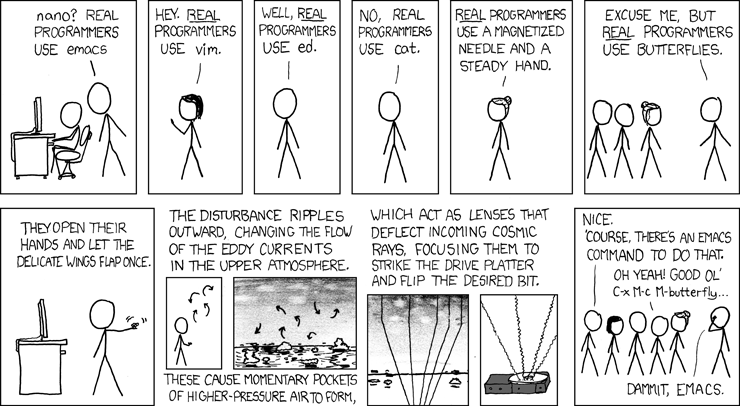
Emacs can do everything, given enough tinkering and custom keystrokes :-) : https://imgs.xkcd.com/comics/real_programmers.png
Lothar Scholz
10/23/2019 6:43 am
I stumbled across Citavi just last week. I was so impressed I bought
Windows 10 and Parallels to try it on my Mac! I am not sure if it is the
infrastructure they use on Windows, but the software runs much slower
than other software in Windows.
They are using a different modern API that uses GPU vector rending for text.
Unfortunately GPU emulation is still very bad in Parallels and VMWare.
It might work better to run Citavi with Windows 7 on Parallels.
I wish Apple themselves were developing tools that the
academic/scholar/researcher could use.
Thats not their audience and they are the master of simplicty not functionality.
(And we shouldn't forget that Apple was never good at developing Software).
Darren McDonald
10/23/2019 8:24 am
@J J Weimer
Thanks for the information about MarginNote vs. LiquidText. I think I will stick with just MarginNote then and see how it goes with my workflow. It is fortunate that there is a macOS and iPad version of this software available.
Let us all know how you go with Flexcil. I would like to read how to felt this appllcation is.
J J Weimer wrote:
Thanks for the information about MarginNote vs. LiquidText. I think I will stick with just MarginNote then and see how it goes with my workflow. It is fortunate that there is a macOS and iPad version of this software available.
Let us all know how you go with Flexcil. I would like to read how to felt this appllcation is.
J J Weimer wrote:
@Darren McDonald
To reference some of your questions/concerns:
* I would not consider MarginNote good enough to use outside its own
eco-system. It does not export anything but flattened PDFs. It does not
do any cloud sync other than iCloud (and that is often unreliable). I
have been able to kludge a work-flow to transfer tagged notes from
Bookends to MarginNote on the iPad.
* I gave up on LiquidText when I found that it munged the import of
annotations from PDFExpert. At least MarginNote imported properly. If I
am going to be limited to using a type of "side-sheet" note system, I
also found the tagging feature of MarginNote to be important in its own
right.
* Flexcil looks like a good app to use to cull notes from documents. It
seems that I have yet another app to try.
Darren McDonald
10/23/2019 8:34 am
@Marbux/Mark
I'm sorry to hear that you got brain damage from a heart attack. My damage came from a hemorrhage. Although strokes affect each person differently, it is great to find a person who knows where I am coming from. :)
I had never heard of NoteCase Pro. Thank you so much for introducing this software to me. I have already installed it and will give it a try. Thanks again!
I have already tried Zotero. Do you use Zotero in combination with NoteCase Pro? How do you use them?
Marbux wrote:
I'm sorry to hear that you got brain damage from a heart attack. My damage came from a hemorrhage. Although strokes affect each person differently, it is great to find a person who knows where I am coming from. :)
I had never heard of NoteCase Pro. Thank you so much for introducing this software to me. I have already installed it and will give it a try. Thanks again!
I have already tried Zotero. Do you use Zotero in combination with NoteCase Pro? How do you use them?
Marbux wrote:
Darren, re your disability with short-term memory, I've walked that path
as the result of a heart attack that did some brain damage.
You might check out Zotero. https://www.zotero.org/
It's not a full-featured research assistant, but I found using the
NoteCase Pro outliner of incredible assistance in working around my
short-term memory loss. https://www.notecasepro.com/
The ability to quickly create lists and then move nodes around within
hierarchical structures is super useful for the memory-impaired when
developing plans. Plus it exports and imports and wide variety of file
formats. Because it can be launched with a command line that instructs
the program to execute a script that can export a result, it can be
incorporated in a workflow with other apps. It's available for MacOS,
the other major operating systems, and Android, but not for iOS, if that
matters.
It's incredibly extensible, with the embedded Lua script interpreter,
374 methods exported to Lua, 3 embedded Lua programming libraries, and
35 scriptable event triggers. Plus scripts can be stored in plain text
files, NoteCase Pro documents, AutoReplace templates, or plugins
(NoteCase Pro documents with some mandatory metadata). I've written
circa 600 scripts for it so far. I know of no other outliner that is so
extensible. If you are of a bent to write scripts, you'd probably find
the program very useful.
Darren McDonald
10/23/2019 8:39 am
@Alex & @gunar
This is the ultimate long-term dream for me, to be able to program to make my very own software. I have long to go before I get this point though. My programming background is just Basic on the Commodore Vic 20! (Am I showing my age? Lol!)
gunars wrote:
This is the ultimate long-term dream for me, to be able to program to make my very own software. I have long to go before I get this point though. My programming background is just Basic on the Commodore Vic 20! (Am I showing my age? Lol!)
gunars wrote:
Alex wrote:
Marbux wrote:
>>I know of no other outliner that is so extensible.
>
>Org-mode. Built on Emacs, which means if you love tinkering,
configuring
>and customizing to fit your specific needs - you can don that forever.
Emacs can do everything, given enough tinkering and custom keystrokes
:-) : https://imgs.xkcd.com/comics/real_programmers.png
Darren McDonald
10/23/2019 8:47 am
@Lothar Scholz
I have a copy of Windows 7 somewhere. I will try it as you recommend. Hopefully, we will see some improvement with the speed. :)
Lothar Scholz wrote:
I have a copy of Windows 7 somewhere. I will try it as you recommend. Hopefully, we will see some improvement with the speed. :)
Lothar Scholz wrote:
I stumbled across Citavi just last week. I was so impressed I bought
>Windows 10 and Parallels to try it on my Mac! I am not sure if it is
the
>infrastructure they use on Windows, but the software runs much slower
>than other software in Windows.
They are using a different modern API that uses GPU vector rending for
text.
Unfortunately GPU emulation is still very bad in Parallels and VMWare.
It might work better to run Citavi with Windows 7 on Parallels.
>I wish Apple themselves were developing tools that the
>academic/scholar/researcher could use.
Thats not their audience and they are the master of simplicty not
functionality.
(And we shouldn't forget that Apple was never good at developing
Software).
Luhmann
10/23/2019 12:31 pm
Darren McDonald wrote:
Hello Luhmann,
I keep reading good things about Paperpile. How do you use Paperpile
specifically?
I use Paperpile to collect and organize references, store academic PDFs, and in Google Drive to format in-text citations and bibliographies for articles as I prepare for publication. They are working on a plugin that will work in MS Word on the desktop and eventually also support other writing apps like Ulysses (my preferred writing app).
What is your workflow in Dynalist? Would you be able to gather
quotations and notes into themes to develop concepts?
I create a document to store the annotations from each PDF. I then structure it to highlight the structure of the article. (When reading I highlight headers and Chapter titles to facilitate this.) Then, in cases where I need to further gather quotations I'll use hashtags. You can filter documents by hashtag, or search hashtags across multiple documents.
satis
11/17/2019 4:40 pm
Are you still using Mubu, or was that just an experiment? (My Chinese is very rusty so I don't think I could use it, but I'm still curious.)
Luhmann
11/17/2019 10:05 pm
Once Dynalist fixed their mobile app I stopped using Mubu. Dynalist’s mobile app still isn’t great, but it is good enough and they improve it regularly. Also I am not willing to store my data on Chinese servers.
khalil
11/19/2019 12:01 pm
Hi Darren,
If your workflow, read -->annotate --->write, i would strongly suggest looking at Atlasti. It is a qualitative analyses software, but works great for literature reviews. You can search for tutorials on doing this. Hope this helps
If your workflow, read -->annotate --->write, i would strongly suggest looking at Atlasti. It is a qualitative analyses software, but works great for literature reviews. You can search for tutorials on doing this. Hope this helps
1
2